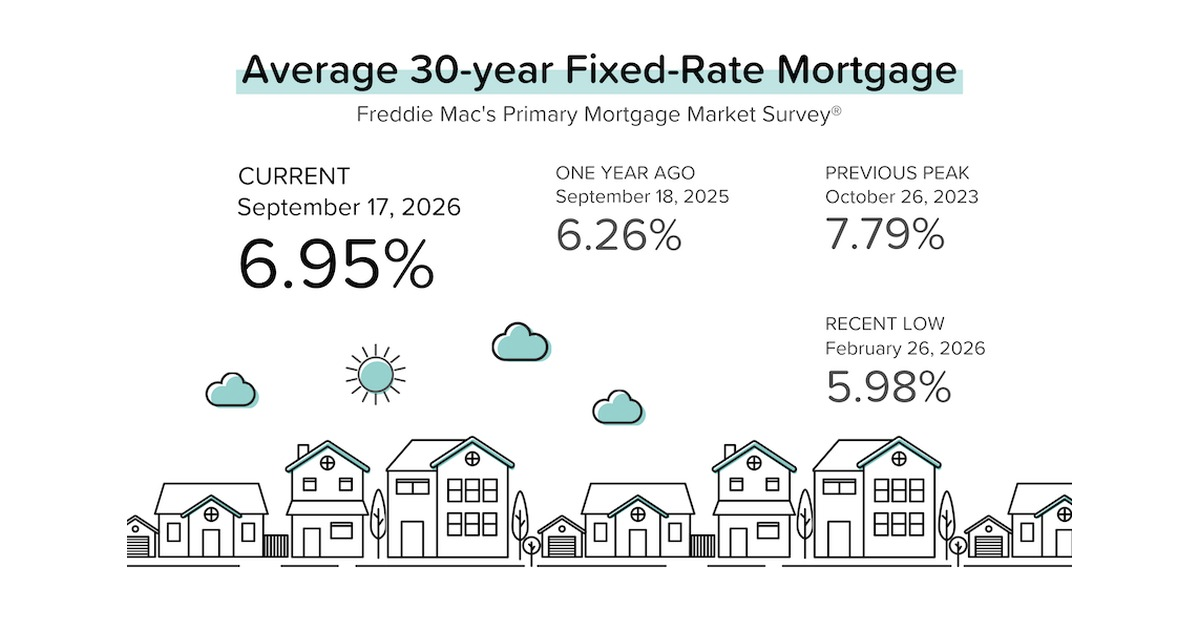
Mortgage rates have climbed back to their highest level in a year. As of September 18, 2026, the average 30-year fixed rate is 7.05%, while Freddie Mac's weekly survey puts the average slightly lower at 6.95%—up from 6.17% this time last year. For a $320,000 loan, that difference adds roughly $186 to the monthly payment compared to a year ago. Here's what's driving the increase and how buyers on the Treasure Coast are adjusting their strategy.
Why Are Mortgage Rates Rising Again in 2026?
Rates briefly dipped below 6% earlier this year, but three forces have pushed them back up:
The Federal Reserve raised rates on September 16. The Fed hiked its benchmark rate by 25 basis points to a target range of 3.75%–4.00%, and signaled more increases could follow, citing a belief that the "neutral" interest rate — the level that neither stimulates nor restricts the economy — has risen. Fixed mortgage rates don't move in lockstep with the Fed's rate, though; they track longer-term bond and mortgage-backed-securities markets, which react to Fed guidance, inflation expectations, and investor demand.
Renewed conflict between the U.S. and Iran has pushed oil prices higher. Energy price spikes tied to the conflict have raised concerns about broader inflation, which historically pushes bond yields — and mortgage rates — higher.
Inflation expectations have firmed back up, giving investors less confidence that rates will ease soon.
How Treasure Coast Homebuyers Are Adapting
Higher rates don't have to mean putting a home search on hold. Buyers in Stuart, Palm City, Hobe Sound, and Jensen Beach are leaning on a few strategies to keep monthly payments manageable:
Rate locks. A rate lock guarantees your interest rate for a set period (typically 30 to 60 days) while your loan closes, protecting you if rates rise further before you get to the closing table. In a rising-rate environment like this one, locking in early is often worth the small fee.
2-1 buydowns. This is a temporary rate reduction, usually paid for by the seller or builder as a concession, that lowers your interest rate by 2% in year one and 1% in year two, then settles at the full rate in year three. It's a popular way to ease into a higher payment, especially for buyers who expect their income to grow or plan to refinance if rates drop later.
Adjustable-rate mortgages (ARMs). An ARM offers a lower fixed rate for an initial period — often 5, 7, or 10 years — before adjusting with the market. For buyers who don't plan to stay in a home long-term, or who expect rates to come down before the adjustment period hits, an ARM can offer meaningful upfront savings.
Should You Wait for Rates to Drop?
It's a fair question, but most forecasts suggest rates are likely to stay elevated for the foreseeable future rather than fall sharply. Waiting also carries its own cost: home prices in Martin County haven't pulled back, so a buyer who waits for rates to drop may simply be trading a lower rate for a higher purchase price. Talking through the math with a lender — comparing a buydown or ARM against your specific timeline — is usually more productive than trying to time the market.
Frequently Asked Questions
What is the average mortgage rate right now?
As of mid-September 2026, the average 30-year fixed mortgage rate is around 7%, according to Freddie Mac's weekly survey and daily rate trackers — the highest level in about a year.
Why are mortgage rates going up in 2026?
A Federal Reserve rate hike, rising oil prices tied to renewed U.S.-Iran conflict, and firming inflation expectations have combined to push mortgage rates higher after a brief dip below 6% earlier in the year.
What is a 2-1 buydown?
A 2-1 buydown temporarily lowers a buyer's mortgage rate by 2 percentage points in the first year and 1 point in the second year, before the rate settles at its permanent level in year three. It's often paid for as a seller or builder concession.
Is an ARM a good idea when rates are high?
An adjustable-rate mortgage can offer meaningful savings during its initial fixed period, making it worth considering for buyers who plan to sell, refinance, or move within that window — but it carries the risk of a higher payment if rates are still elevated when it adjusts.
Will mortgage rates go down soon?
Most economists expect rates to stay elevated in the near term rather than drop significantly, given ongoing inflation pressure and geopolitical uncertainty. Buyers who need a home now are generally better served by exploring rate locks and buydowns than waiting on a rate forecast.
Financing a purchase on the Treasure Coast? Get in touch or call/text 772-288-1765 — I can walk you through which strategy fits your timeline and budget.
Sources:
