Treasure Coast Real Estate Blog

Aug. 17, 2026

Getting Preapproved for a Mortgage: What First-Time and Move-Up Buyers Need to Know

Quick answer: Mortgage preapproval is a lender's written commitment — based on a thorough review of your income, credit, and assets — that tells you how much you can borrow. It's different from prequalification (a rough, unverified estimate), and it's the single step that turns "just looking" into "ready to make an offer." Most W-2 buyers with straightforward finances can get preapproved in 24–48 hours once paperwork is in.

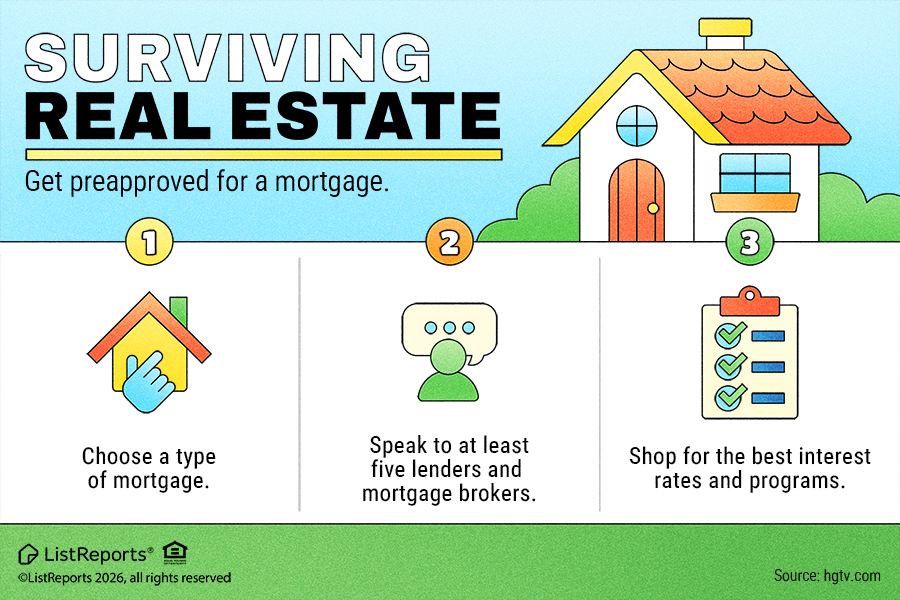
Surviving Real Estate - Get Preapproved for a Mortgage

A strong offer starts well before you find the home you want to buy. Getting your financing in order early helps you understand your budget, shop with confidence, and act fast when the right home comes along — and on the Treasure Coast, where well-priced homes can move quickly, that head start matters. Below is what preapproval actually involves, what to gather, and how the process looks a little different depending on whether this is your first home or your next one.

Preapproval vs. Prequalification: They're Not the Same Thing 

Quick answer: Prequalification is a quick, informal estimate based on numbers you self-report. Preapproval is a verified, underwritten commitment based on documents a lender actually checks — pay stubs, tax returns, bank statements, and a credit pull.

Sellers and listing agents know the difference, too. In a competitive market, an offer backed by real preapproval carries far more weight than one backed by a same-day prequalification estimate. If you're serious about buying within the next few months, preapproval — not prequalification — is the step worth doing.

Documents You'll Need for Preapproval

Gathering these ahead of time is the single biggest thing you can do to speed up the process. Most lenders will ask for some version of the following:

Identity and employment

  • Government-issued photo ID
  • Recent pay stubs (last 30–60 days)
  • W-2s from the last two years

Financial documentation

  • Bank statements, all accounts (last two months)
  • Federal tax returns, last two years, with schedules
  • Investment and retirement account statements
  • A list of your current monthly debts

Housing and credit

  • Current mortgage statement, if you already own
  • Landlord/rental history, if you're renting
  • Authorization for the lender to pull your credit report

If it applies to you

  • Gift letter, if part of your down payment is a gift
  • Business tax returns and profit-and-loss statements, if you're self-employed

Borrowers with simple, W-2 income who submit everything up front can sometimes get preapproved in as little as 24–48 hours. Self-employed borrowers or more complex financial situations typically take longer, so it's worth starting this conversation with a loan officer early — even before you start touring homes.

If This Is Your First Home

First-time buyers tend to have two things on their mind going into preapproval: How much can I actually afford? and Do I have enough for a down payment? A good loan officer will walk through both, and there's more flexibility here than many first-time buyers expect.

A few things worth asking about specifically:

  • Down payment assistance and first-time buyer programs — many are available at the state or local level and can lower the amount you need up front.
  • Gift funds — if family is helping with part of your down payment, ask what documentation the lender needs to avoid delays later.
  • Building or protecting your credit — even small, avoidable mistakes (opening a new credit card, financing a car) between preapproval and closing can affect your approval, so it's worth asking your loan officer what to avoid during the process.
  • Debt-to-income ratio — lenders typically want your total monthly debts, including the new mortgage, to fall within roughly 43–50% of your gross monthly income, depending on the loan type.

None of this needs to be figured out alone. Part of what a good real estate agent and loan officer do together is make sure a first-time buyer understands not just what they qualify for, but what payment they'll actually be comfortable with.

If You're Moving Up

Move-up buyers face a different puzzle: you likely have equity in your current home, but that equity is tied up until you sell — which raises the question of whether you buy first, sell first, or try to do both at once.

  First-time buyer Move-up buyer
Down payment source Savings, gifts, or assistance programs Often equity from current home
Key question What can I afford? Buy first or sell first?
Preapproval complexity Usually straightforward May involve contingencies or bridge financing
Timing pressure Lower — no home to sell Higher — two transactions to coordinate
Extra tools to ask about Down payment assistance, gift letters Home sale contingency, bridge loan, HELOC


A few options worth discussing with your lender if you're in this position:

  • A contingent offer — making your purchase dependent on the sale of your current home. It protects you financially but can make your offer less competitive in a fast-moving market.
  • A bridge loan — short-term financing that lets you access equity from your current home before it sells, so you can buy without waiting. It works well in some situations and isn't worth the cost in others, so it's a conversation to have with your loan officer, not a default assumption.
  • A HELOC on your current home, opened before you list it, as another way to access equity for your next down payment.
  • Carrying two mortgages temporarily — some buyers qualify to hold both loans briefly if the numbers support it; your lender can tell you quickly whether that's realistic for your situation.

There's no single right answer here — it depends on your equity, your comfort with timing risk, and what the local market looks like right now. This is exactly the kind of decision worth making with your agent and lender together, before you're under time pressure.

How Long Does Preapproval Last?

Quick answer: Most preapproval letters are valid for 30–60 days. If your home search runs longer than that, your lender will typically just need updated pay stubs or bank statements to refresh it — it's usually quick, not a full re-application.

Frequently Asked Questions

Does getting preapproved hurt my credit score? A preapproval typically involves a hard credit inquiry, which can cause a small, temporary dip in your score. Multiple mortgage inquiries within a short shopping window (typically 14–45 days, depending on the scoring model) are usually counted as a single inquiry, so it's fine to compare a couple of lenders.

Can move-up buyers get preapproved before their current home sells? Yes. Lenders can preapprove you based on your current financial picture, and then work with you on strategy — contingent offer, bridge loan, or carrying two mortgages — depending on how your numbers look once you're ready to write an offer.

How much does preapproval cost? Preapproval itself is typically free or low-cost through most lenders, though some may charge a fee for a credit report pull. Ask upfront so there are no surprises.

What's the difference between preapproval and final loan approval? Preapproval is based on documentation you provide before you find a home. Final approval happens after you're under contract, once the lender has verified everything and the home has appraised.

Ready to Get Started?

A strong offer starts well before you find the home you want to buy. If you're thinking about buying — whether it's your first home or your next one — send me a message and let's build the right team around you, starting with a loan officer who can help you choose financing that actually fits your goals.

Contact Eric Slifkin and the Slifkin Real Estate Team to get connected with a trusted local lender and start your preapproval.


Eric Slifkin is a Broker Associate with Keller Williams Realty Treasure Coast, serving buyers and sellers across Martin, St. Lucie, and Indian River counties.

Aug. 13, 2026

5 Questions to Ask Before Falling in Love With a House

It's easy to get swept up in beautiful finishes or the perfect backyard, but a smart home purchase goes beyond what you see at first glance. Asking the right questions can help you uncover important details, understand what you're buying, and make a more informed decision before moving forward. Here on the Treasure Coast — where waterfront views, charming homes, and luxurious planned communities can make it especially easy to lead with your heart — a little curiosity up front goes a long way. Before you let yourself fall completely in love, walk through these five questions first.

Couple viewing a home before buying a house on Florida's Treasure Coast

1. What's the real cost of insurance here?

Florida homeowners insurance has changed a lot in the last few years, and premiums can vary dramatically from one property to the next — even two houses on the same street. Before you get attached, ask your agent or lender for a rough insurance estimate based on the home's age, roof condition, and construction type. It's also worth finding out whether the property sits in a flood zone, since flood coverage is typically a separate policy from standard homeowners insurance. A home that looks affordable on paper can become much more expensive once insurance is factored in, so this is one question worth answering early rather than after you're already picturing yourself on the lanai.

2. How old is the roof, and what shape are the major systems in?

Roof age matters everywhere, but it matters even more in Florida, where insurers increasingly factor roof condition into whether they'll write a policy at all — and at what price. Ask when the roof was last replaced or inspected, and do the same for the AC system, water heater, and electrical panel. Big-ticket items like these are expensive to replace and can also affect your ability to get favorable insurance terms. A seller or listing agent should be able to share this information, and a home inspection will confirm it.

3. Are there HOA or condo association fees, and what do they actually cover?

Many Treasure Coast communities, especially those with shared amenities like pools, gated access, or waterfront access, have a homeowners' or condo association. Ask what the monthly or annual fees are, whether they've increased recently, and what they include. It's also smart to ask about the association's reserve funds and any planned or recent special assessments — Florida condo associations in particular have faced new reserve requirements in recent years, and a healthy reserve fund can save you from an unexpected bill down the road.

4. What's the flood and elevation history of this property?

Living near the water is part of the Treasure Coast's appeal, but it's worth understanding what that proximity means in practice. Ask about the home's flood zone designation, its elevation certificate if one exists, and whether the property or neighborhood has flooded in the past. This isn't about talking yourself out of a home you love — it's about knowing what you're taking on, from insurance costs to peace of mind during storm season.

5. Why is the seller moving, and how long has the home been on the market?

This question can tell you a surprising amount. A quick sale after a job relocation is very different from a home that's lingered on the market for months, which can sometimes signal pricing issues, needed repairs, or other concerns that make buyers hesitant. Understanding the seller's motivation can also help shape your offer and negotiation strategy. Your agent can often get a read on this through the listing agent, even if it's never stated outright.

Ask the questions, then fall in love with confidence

None of this is about talking yourself out of a home — it's about making sure the home you fall for can actually hold up to a closer look. The buyers who feel most confident at closing are usually the ones who asked good questions early, not the ones who skipped straight to the offer.

That's where having an experienced local agent in your corner makes all the difference. The Slifkin Real Estate Team knows the Treasure Coast inside and out, from flood zones in Stuart to HOA quirks in Palm City to what to expect on Hutchinson Island, and we're happy to walk through these questions with you on any home you're considering.

Ready to find a home you can feel confident about? Contact the Slifkin Real Estate Team today.

Get in Touch with the Slifkin Real Estate Team

Aug. 11, 2026

5 Tips for First-Time Homebuyers

Buying your first home is a big milestone, and a little preparation can go a long way toward making the process feel more manageable. 🏡 Building the right team and understanding your options before you start house hunting can help you move forward with confidence. If you're ready to take the first step, send me a message and let's get started!


Aug. 11, 2026

Home Value Estimates — Agent vs Internet

Why Online Tools Miss the Mark — and What Really Determines Your Home's Value

By Eric Slifkin, Broker Associate | Keller Williams Realty Treasure Coast


You've probably typed your address into Zillow, Redfin, or one of a dozen other online estimators and watched a number pop up instantly. It feels like information — but how accurate is it, really?

The short answer: not very. And if you're planning to sell your home on the Treasure Coast, relying on that number could cost you thousands.

Home Value Estimates

What Online Estimates Actually Do

Sites like Zillow (with its "Zestimate") and Redfin use automated valuation models — algorithms that pull together publicly available data such as tax records, prior sale prices, and general neighborhood trends. They're fast, they're free, and they're useful for casual curiosity.

But here's what they can't do:

See inside your home. That renovated kitchen, the new roof, the custom pool cage — the algorithm doesn't know they exist.

Account for condition. A home that's been meticulously maintained versus one that's been neglected can differ by tens of thousands of dollars, even on the same street.

Measure real-time buyer demand. Is there a bidding war happening right now in your neighborhood? Are out-of-state buyers flooding Martin County this month? No algorithm tracks that in real time.

Understand your layout and lot. A corner lot, a water view, a dead-end street — these details move the needle significantly, and no database captures them accurately.

Reflect off-market activity. Many Treasure Coast transactions, especially in the luxury segment, happen off-MLS. That data never makes it into the algorithm.

Zillow itself has acknowledged that its Zestimate carries a median error rate of roughly 2–3% for on-market homes — and significantly higher for off-market properties. On a $650,000 Martin County home, a 3% error is nearly $20,000 in either direction.


What a Local Agent Does Differently

A Comparative Market Analysis (CMA) from an experienced Treasure Coast agent isn't just a number — it's a judgment call backed by real data and local knowledge.

Here's what goes into a professional home valuation:

Recent comparable sales — Not just any sales, but the right ones. Similar square footage, lot size, and finishes; sold within the last 90 days. In a market as varied as Martin County — where a waterfront home in Sewalls Point and a golf course villa in Mariner Sands are both technically "Stuart" — choosing the right comps is an art.

Active listing competition — What are buyers looking at right now? If three similar homes are sitting on the market at $675K, pricing yours at $699K requires a compelling reason. Your agent knows what's out there.

Market velocity — Are homes selling in 30 days or 90? Are sellers getting full asking price or accepting concessions? In June 2026, Martin County single-family homes were going under contract in a median of 48 days — down from 56 days a year ago. That's a meaningful shift that affects how you price and when you list.

Buyer demand trends — Cash buyers represented 46% of Martin County closings in June 2026. That tells you something about who's shopping and what they value. A local agent reads those signals and prices accordingly.

Your home's specific features — Impact windows, a whole-house generator, an updated primary suite, a three-car garage. These add real value that no automated tool can quantify.


The Cost of Getting It Wrong

Overpricing your home is the most common and costly mistake sellers make. A home that sits on the market too long develops a stigma — buyers wonder what's wrong with it. Price reductions signal weakness and often result in a final sale price lower than it would have been if the home had been priced correctly from day one.

Underpricing is less common but equally damaging. Leaving $20,000, $30,000, or more on the table because you trusted an algorithm over a professional is a real risk in a market where inventory compression is working in sellers' favor.

The right price — informed by a skilled agent's analysis — is the one that attracts qualified buyers quickly, generates competitive interest, and closes at or near full value.

What's Your Treasure Coast Home Actually Worth?

If you're curious about your home's value — whether you're thinking about selling now or want to know where you stand — we'd be happy to put together a no-obligation Comparative Market Analysis for your specific property.

We serve Stuart, Palm City, Jensen Beach, Hobe Sound, Hutchinson Island, Sewall's Point, Tequesta, and communities throughout Martin and St. Lucie Counties.


Get Your Free Home Valuation →

Or call Eric Slifkin directly: 772-288-1765

The Slifkin Real Estate Team at Keller Williams Treasure Coast


Aug. 5, 2026

Should You Sell or Rent Your Home? What Your Low Mortgage Rate Means Right Now

If you bought or refinanced your home between 2019 and 2021, there's a good chance you're sitting on a mortgage rate most buyers today would love to have. That's a great position to be in — until you need to move. Right now, nearly half of all homeowners have a mortgage rate of 4% or lower, and almost 8 in 10 have a rate below 6%. The average rate on a new 30-year mortgage, meanwhile, is sitting at 6.58%. That gap is why so many homeowners are asking the same question: should I sell my house or rent it out instead?

Are you an accidental landlord?

Image Source: The Close

Why your low rate makes selling feel expensive

Here's the tradeoff nobody loves to think about: when you sell your current home, you also give up your current mortgage. If you buy another home, you'll likely finance it at today's rate — which could be two points or more above what you're paying now. On a similarly priced home, that difference can add hundreds of dollars to your monthly payment.

Research on this exact situation found that for every one-point gap between your original rate and today's rate, you become roughly 18% less likely to sell. It's not that homeowners don't want to move — it's that moving now costs more than it used to.

Of course, life doesn't always wait for interest rates to drop. A new job, a growing family, a divorce, or a relocation can make moving necessary regardless of the math. That's exactly why more owners in your position are choosing a third option: renting out their current home instead of selling it.

Why more homeowners are renting instead of selling

You're not alone if this feels like new territory. A recent analysis of rental listings found that 2.3% of homes currently for rent had been listed for sale within the past few months — the second-highest share recorded in nearly six years. In plain terms: a growing number of people who tried to sell their home ended up renting it out instead, often without ever planning to become a landlord.

This shift shows up most in places where homes are taking longer to sell, and buyers have more negotiating power — markets like Denver, Houston, Austin, and San Antonio. Single-family homes are especially likely to become rentals, more so than townhomes or condos, because they tend to attract stronger rental demand.

If your home didn't sell — or you're hesitant to list it because of what you'd give up — renting might be worth a serious look. But it's not automatically the right move for everyone.

What is an "accidental landlord"? An accidental landlord is a homeowner who ends up renting out their property without ever planning to be in the rental business — usually because selling stopped making financial sense. If that sounds like where you're headed, read our full guide: Becoming an Accidental Landlord →

What renting your home actually costs.

Before you decide to keep your house and rent it out, it helps to know that renting isn't free money on top of your mortgage. Your rental income needs to cover realistically:

  • Your mortgage principal and interest
  • Property taxes and homeowners insurance
  • HOA dues, if applicable
  • Vacancy periods between tenants
  • Repairs and maintenance
  • Property management fees, if you hire help

If you have significant equity and a low payment, you likely have more flexibility to rent profitably or to hold out for the right offer. If your margins are tight, renting could end up costing you more than a price adjustment would have.

How to decide: sell or rent?

The clearest way to answer this question is to compare your options side by side rather than guessing. Before you decide, it's worth gathering:

  1. What your home could realistically sell for, based on recent comparable sales in your area.
  2. What your home could realistically rent for, based on current listings nearby.
  3. Your full costs as a landlord — mortgage, taxes, insurance, HOA, maintenance reserves, and management, if you don't plan to self-manage.
  4. How long you'd actually need or want to rent the home, and what your plan is after that.
  5. Your reserves — enough to cover a vacancy, a major repair, or a slow rental season without financial strain.

Once you can see your likely sale proceeds next to your likely rental cash flow, the right decision usually becomes much clearer. And because taxes, insurance, legal requirements, and day-to-day property management each come with their own rules, it's worth looping in a CPA, an insurance agent, an attorney, and a property manager before you commit either way.

The bottom line

Your mortgage rate isn't just a number from your closing paperwork — right now, it's one of the biggest factors in whether selling or renting makes more financial sense. Neither option is automatically better. But running the numbers before you decide can save you from a costly surprise, whether that's an underpriced sale or an unprofitable rental.

If you're weighing whether to sell or rent your home, we can walk you through both scenarios and help you see the real numbers before you decide. Reach out to schedule a consultation.


Source: The Close

July 18, 2026

Treasure Coast Real Estate Update

Whether you're thinking about buying, selling, or simply keeping an eye on your home's value, staying current on market conditions is one of the smartest things you can do. This update covers what's happening nationally with mortgage rates and housing supply — and what it means specifically for buyers and sellers here on the Treasure Coast.

reasure Coast Florida real estate market chart showing home prices and inventory trends

What's Happening with Mortgage Rates

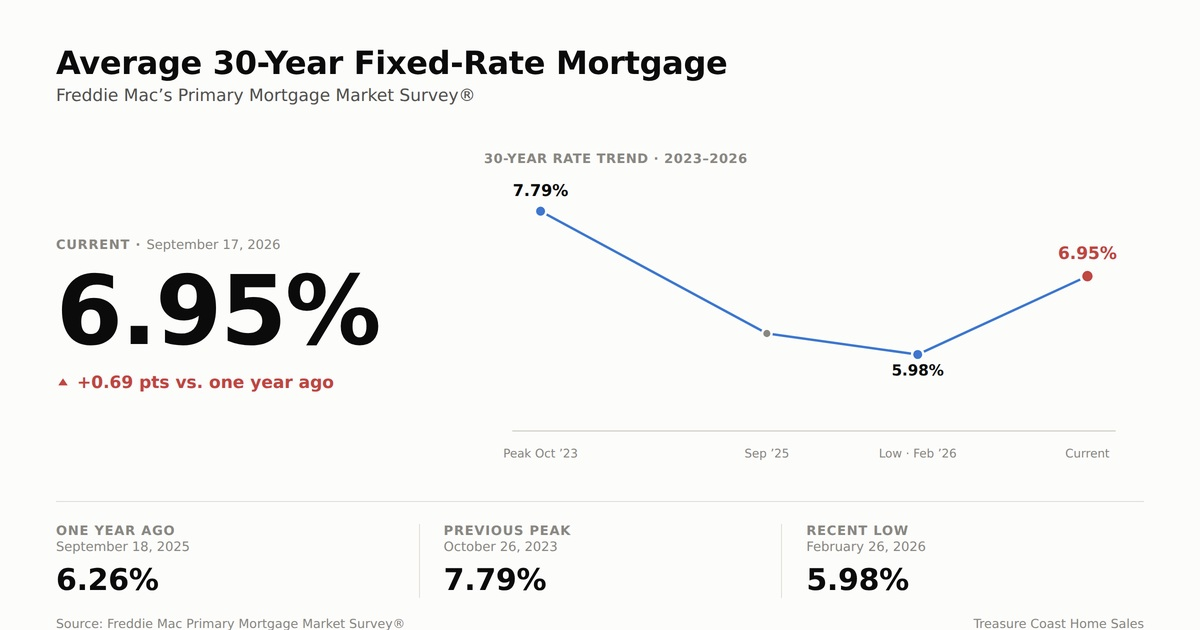
The 30-year fixed-rate mortgage averaged 6.58% for the week ending July 23, 2026, up from 6.55% the prior week — its highest level since August 2025. Renewed tension in the Middle East is pushing oil and gas prices higher and raising concerns about the potential for broader inflation in the months ahead. Freddie Mac Money

The Fed held rates steady in 2026 while evaluating new economic data, pausing any cuts after a series of reductions in late 2025. The Mortgage Bankers Association forecasts 30-year fixed rates will remain in the mid-6% range through year-end, with rates projected around 6.5% for the third and fourth quarters. ForbesCreditandcollectionnews

For Treasure Coast buyers, rate relief isn't on the horizon in the near term. Buyers financing a purchase should be working closely with a lender now to explore rate locks, 2-1 buydown programs, and whether an adjustable-rate mortgage makes sense for their timeline. Waiting for rates to drop may mean competing in a more active market when they do.

National Housing Supply

Nationally, total housing inventory stood at 1.65 million units in June 2026, up 1.3% from June 2025, with a 4.6-month supply of unsold homes — unchanged from a year ago. Nationally, total existing home sales increased 2.8% year-over-year to a seasonally adjusted annual rate of 4.09 million. The national median existing home price rose to $440,600, up 1.8% from a year ago — the 36th consecutive month of year-over-year price increases. miamirealtorsmiamirealtors

The broader picture remains a market finding its footing in a persistently high-rate environment — with enough activity to keep values supported, but enough hesitation to give prepared buyers real negotiating room.

What This Means for Treasure Coast Buyers

More inventory and longer days on market in some pockets have handed buyers more leverage than they've had since before 2021. You have time to look carefully, negotiate on price and terms, and avoid the panic-offer dynamics of the last few years.

That said, the Treasure Coast is not a distressed market. Martin County inventory is actually down sharply year-over-year, keeping values well-supported. The opportunity is real — but so is the competition for the best properties.

If you're pre-approved and ready to move, this may be one of the better entry windows the Treasure Coast has offered in several years.

What This Means for Treasure Coast Sellers

Pricing discipline is everything right now. Buyers are taking their time, and overpriced listings are sitting while correctly priced ones move. The sellers doing best are those who price accurately based on recent comparable sales, prepare the home carefully, and work with an agent who has genuine marketing reach beyond the MLS.

The good news: Martin County's inventory compression is working in sellers' favor. Fewer competing listings mean your well-prepared, well-priced home has a real audience.

Local Market Snapshot — July 2026

Conditions vary meaningfully across the Treasure Coast. Here's a breakdown by area:

Stuart & Martin County

The June 2026 data from MIAMI REALTORS® is notably strong. Total Martin County home sales rose 21.8% year-over-year in June 2026, the third consecutive month of year-over-year gains. Single-family transactions climbed 11.3%, while condo sales surged 46.7%. miamirealtors

The median sale price for Martin County single-family homes rose to $655,000 in June 2026, up 1.1% year-over-year. Total active listings fell 21.7% year-over-year to 1,283 — with single-family inventory down 22.9% to just 724 homes. That supply compression translates to a 3.9-month supply for single-family homes — firmly a seller's market. miamirealtors

Cash sales represented 46.2% of all Martin County closed sales in June 2026 — nearly double the national average of 25% — reflecting the continued strength of wealth migration and international buyer demand in our market. miamirealtors

The median time from listing to contract for single-family homes was 48 days, down from 56 days a year ago — a positive sign of improving demand momentum. Read More miamirealtors

Palm City

Family-oriented communities such as Martin's Crossing, Hammock Creek, and Highlands Reserve continue to attract buyers seeking A-rated schools and more space. Martin County's overall inventory compression supports values here, and Palm City remains one of the most consistently in-demand pockets on the Treasure Coast.

Jensen Beach & Hutchinson Island

The condo market is running at roughly 73–122 days from listing to sale for most units. Martin County condo inventory decreased 20% year-over-year to 559 active listings, with a 6.1-month supply — a balanced market. Well-maintained, amenitized units with water views are moving faster, while older or less-updated buildings are presenting real negotiating opportunities for buyers. miamirealtors

Port St. Lucie & Tradition

Tradition continues to offer value relative to Martin County, with builder incentives on new construction remaining competitive. Buyers comparing resale to new construction in this corridor should factor in those incentives carefully before making a decision.

Hobe Sound & Tequesta

These markets continue to attract buyers priced out of Jupiter and Palm Beach County who still want the lifestyle and water access at a lower price point. With Martin County inventory compressed overall, Hobe Sound in particular offers compelling waterfront value relative to comparable properties to the south.

The 21st Century ROAD to Housing Act — Now Law

The 21st Century ROAD to Housing Act became law on July 11, 2026 — the most sweeping federal housing package in decades. The provision most relevant to Treasure Coast buyers bars large institutional investors (those owning 350+ single-family homes) from buying additional existing homes, removing one source of competition from the resale market. The rest targets housing supply — streamlining environmental review and zoning for new construction and expanding affordable housing funding.

Locally, the investor restriction is worth watching in Martin County, where cash buyers already make up nearly half of closed sales. The supply-side reforms could eventually support more new construction in Port St. Lucie and Tradition, though effects will take time to show up in local data. This is a structural, long-term bill — not a rate fix — but we'll keep tracking its local impact.

Source: Bipartisan Policy Center, NPR

Ready for a Personalized Look at Your Home's Value?

National headlines tell part of the story — but real estate is local, and what's happening on your street matters more than any national average. Whether you're thinking about selling in the next 6 months or want to understand what your home is worth right now, we're happy to put together a no-pressure market analysis for your specific property.

Contact Eric Slifkin for your free Treasure Coast market analysis — or view our full market reports for detailed area data.

July 17, 2026

The 21st Century ROAD to Housing Act Is Now Law: What It Means for Treasure Coast Buyers and Sellers

The 21st Century ROAD to Housing Act — the most significant federal housing legislation in decades — is officially law. It became effective on July 11, 2026, after President Trump let the 10-day review window lapse without signing or vetoing it, an unusual path to enactment that followed a bipartisan 358-32 vote in the House and an 85-5 vote in the Senate in late June.

Road to Housing Act

Here's what's actually in it, and what it does (and doesn't) mean if you're buying or selling on the Treasure Coast.

Why This Law Exists

The backdrop is a real affordability squeeze. The median price of an existing home nationally hit $440,600 in June 2026 — up 49.2% from June 2020 — while 30-year mortgage rates are still hovering above 6.5%. Realtor.com estimates the U.S. is short roughly 4 million homes relative to demand. The Act is a bipartisan attempt to chip away at that gap by targeting the regulatory and financing bottlenecks that slow new construction.

The Provisions That Matter Most

Limits on large institutional investors. Investors who already own at least 350 single-family homes are now barred from purchasing additional single-family homes, with exceptions carved out for certain build-to-rent and renovate-to-rent projects and programs that help renters build credit toward eventual homeownership. The intent is to curb corporate competition for existing housing stock, particularly in Sun Belt markets where institutional buying has drawn scrutiny — though economists note investor activity is relatively light in many of these markets to begin with.

Zoning and permitting reform. The law streamlines environmental review requirements under the National Environmental Policy Act (NEPA) for housing projects, expands categorical exclusions, and creates competitive grants to help local governments modernize zoning and land-use rules. It also allows HUD to delegate certain reviews to states and localities — aimed at reducing the time and cost of getting new housing approved and built.

A broader definition of "manufactured home." The law updates the federal definition to include factory-built homes that are not constructed on a permanent steel chassis. Removing that requirement could lower the cost of a manufactured home by an estimated $5,000–$10,000, according to the Niskanen Center, making it a more viable entry point to homeownership.

A small-dollar mortgage pilot. A new four-year pilot program aims to expand access to mortgages under $100,000 — loans many lenders currently avoid due to compliance costs — by subsidizing lenders to originate them and offering borrowers grants for down payments and closing costs. This could matter most in lower-cost pockets of the market.

What This Means Locally

For Treasure Coast buyers and sellers, the honest answer is: don't expect overnight change. As Cotality chief economist Selma Hepp put it, "housing development takes time and many of the benefits would likely materialize gradually rather than overnight." Zoning and permitting are still fundamentally local decisions — Martin, St. Lucie, and surrounding county and municipal rules will determine how much of this translates into new supply here, and on what timeline.

That said, a few things are worth watching:

If institutional buyers pull back on single-family acquisitions, that could modestly ease competition for move-in-ready homes in the price ranges those investors have favored.

Local zoning grant funding could eventually support more housing variety in our area, though any impact will lag well behind the law's effective date.

Buyers priced out of conventional financing may want to keep an eye on the small-mortgage pilot program as it rolls out — it could open doors for lower-cost purchases, including some manufactured and 55+ community housing.

Bottom Line

This is a real, structurally significant piece of legislation — the biggest housing bill since 1990 — but it's a long-term supply and financing fix, not a quick fix for today's prices or rates. If you're weighing a move in this market, the fundamentals that matter right now are still local: pricing strategy, timing, and understanding your specific market segment. That's where I can help. Questions about your home-buying or selling plans? Let's talk.

Sources:

Eric Slifkin, Broker Associate

Keller Williams Realty Treasure Coast

O: 772-678-1600 · C: 772-288-1765

Get in Touch


July 14, 2026

Selling Your Home? Here's What You Need to Know About Your Marketing Options

If you're thinking about selling your home, you've probably assumed there's only one way to do it: put it on the market, list it on the MLS, and let the world see it. In most cases, that's exactly the right move. But it's not the only option — and as your agent, it's my job to make sure you know all of them before we decide together how to market your home.

Marketing Plan to Get Your Home Sold for Top Dollar

Here's a breakdown of the three main paths sellers can take, and why you might choose one over another.

Option 1: Full MLS Marketing (the right call for most sellers)

This is the traditional, tried-and-true approach, and it's still the best choice for the vast majority of sellers. Your home gets listed on the MLS and is broadly exposed to every agent and buyer in the market — not just those working with my brokerage.

Why it works: more eyes on your listing mean more competition, and more competition typically means stronger offers. You also get full transparency, accurate pricing history, and immediate syndication to the major real estate websites that buyers scroll through every day. Fair housing and equal opportunity protections are baked into the process, too.

If your goal is to sell for the most money in the least time, this is almost always the way to go.

Option 2: Office Exclusive Listing (for sellers who need privacy)

Sometimes maximum exposure isn't the priority — privacy is. An office exclusive listing is filed with the MLS but is not publicly marketed or advertised. It's shared only with agents inside my own brokerage, meaning it never hits the open market.

This option tends to make sense for sellers dealing with unique circumstances: a high-profile situation where discretion matters, personal or family circumstances you'd rather keep private, or simply wanting to quietly test the waters before committing to a full public launch.

The tradeoff is real: you're giving up the broad exposure and buyer competition that come with full MLS marketing. That's why I'll always walk you through exactly what you're gaining and giving up before you choose this route — it should be an informed decision, not a default one.

Option 3: Coming Soon / Delayed Marketing (the best of both worlds)

This is the strategic middle ground. A "Coming Soon" or delayed marketing listing lets us build early buzz and generate buyer interest before your home officially hits the public market.

It also buys us something valuable: time. Time to finish staging, nail the photography, and get every detail right — without the pressure of a live listing already sitting on the market. Your home stays on the market and MLS-visible throughout, just on a timeline that works for you instead of racing to post on day one.

For sellers who want a strong launch without sacrificing prep time, this option often strikes the right balance.

So, Which Option Is Right for You?

There's no universal answer — it depends on your goals, your timeline, and your circumstances. Maybe maximum exposure and the strongest possible offer is exactly what you want. Maybe privacy matters more to you right now. Maybe you just need a few extra weeks to get your home market-ready without the clock already running.

Whatever the case, my job is to explain each option clearly, make sure you understand the trade-offs, and support whichever path best serves your interests — because that's the whole point.

Thinking about selling? Let's talk through your options.

Posted in Home Selling
July 12, 2026

Treasure Coast Housing Market

TCPalm's Housing Market 2026

Curated articles about the changing real estate market on Florida's Treasure Coast. [Source: Jack Randall, TCPalm.com]

Treasure Coast Living

Home Prices Rise in all but 1 Treasure Coast County as Inventory Drops

Treasure Coast home prices are rising as inventory tightens, creating a competitive market for local buyers. Home prices are rising as inventory falls on the Treasure Coast. Median sale prices for Martin and Indian River counties increased in May compared to May 2025. The median sale price in St. Lucie County was unchanged compared to last year. The stability has been reassuring, as St. Lucie County shows several signs of "economic strain and mortgage distress," according to a report by real estate data company ATTOM. The county had a foreclosure rate higher than 90% of all U.S. counties. The number of homes sold fell in St. Lucie and Indian River counties, while rising in Martin County, compared to last year. The number of homes on the market decreased in all three Treasure Coast counties. [Source: TCPalm, 6.25.26]  Read More


Florida Home Mortgages Denied at a High Rate in St. Lucie County

Prospective homebuyers in St. Lucie County have both purchased home loans and been denied mortgages at the highest rates on the Treasure Coast and South Florida, according to a TCPalm analysis of federal data. St. Lucie County had the second-highest rate of mortgage purchases in 2024 among Florida counties, according to the TCPalm analysis. However, it also had a high rate of denials, shutting many families out of homeownership. [Source: TCPalm, 4.07.26]


Population Growth Slows on the Treasure Coast

Population growth in Port St. Lucie, once the fifth-fastest-growing metropolitan area in the nation, slowed during 2024-2025, according to a recent U.S. Census report, dropping the city to the 14th-fastest-growing metro area. The Port St. Lucie metro area, which includes Martin and St. Lucie counties, grew by 2.14% last year, according to U.S. Census data. It's the lowest annual percent growth since the post-pandemic population boom, which has averaged 3%. [Source: TCPalm, 3.31.26]


Real Estate Market Dips Again for Condos and Townhomes in St. Lucie County

The median sale price for townhouses and condominiums in St. Lucie County dropped by $75,000 from last year. In contrast, median sale prices for other Treasure Coast counties remained mostly steady in February. Last month, St. Lucie County had a median sale price of $250,500 for townhouses and condos, 23% less than in February 2025, according to a TCPalm analysis of Realtor data. [Source: TCPalm, 3.25.26]


Florida Real Estate Market Sees Home Prices Plummet in Martin County

The median price of homes in Martin County was about $100,000 less than last year's median sale price. In contrast, median sale prices for other Treasure Coast counties remained mostly steady in February, and the number of homes on the market dropped in all three Treasure Coast counties compared to last year. [Source: TCPalm, 3.24.26]


Florida Local Condo, Townhome Prices Drop

The townhouse and condominium market on the Treasure Coast is going through notable changes, with median sale prices falling and inventory increasing in some areas. The median sale price for townhouses and condos in Indian River County dropped to $185,250 in January, the lowest in years, based on data from local Realtors. The county also recorded the highest number of new listings in a single month. Martin, St. Lucie, and Indian River counties all began the year with a slowdown, according to Realtor data. "The condo and townhome market is clearly adjusting, with higher inventory and softer prices creating short-term pressure," Robenson Juste, president of the Realtors Association of Indian River County, said in a statement. [Source: TCPalm, 2.26.26]


Local Real Estate Market Flooded with Home Listings in January

January experienced the largest single-month increase in new home listings in years, according to local Realtor data. The first month of the year is typically the most popular time to list homes on the Treasure Coast market. Notably, last month saw 1,905 new listings, according to Realtor data, which is 22% more than in January 2025. However, the median home sale price in Martin County dropped by nearly $100,000 from last year, according to local Realtor data. In contrast, median home sale prices in St. Lucie and Indian River counties increased during the same period.[Source: TCPalm, 2.25.26]


Are you looking to buy or sell a Treasure Coast home? Partner with our experienced agents in Stuart, Florida, to navigate the housing market shift. Looking to sell? Maximize your property's visibility to attract more potential buyers and achieve your real estate goals. Contact us today!


Posted in Market Reports, News
June 29, 2026

The Risks of Pricing Your Home Too High

When you decide to sell your home, it's tempting to set a high asking price. Maybe you've seen what a neighbor got last year, or Zillow's Zestimate is flattering, or you just want room to negotiate. It's a natural instinct — but it's one of the most expensive mistakes a seller can make. Here on the Treasure Coast, we see it regularly: a well-maintained home sits on the market for 60, 90, even 120 days while comparable homes sell in weeks. Almost always, the culprit is the same — it was priced too high from the start. Here are five very real risks of overpricing your home, and why the right price from day one is almost always the better strategy.

Treasure Coast home seller reviewing listing price strategy with real estate agent

1. You Miss the Most Important Window — the First Two Weeks

The moment your home is listed, it gets a surge of attention from buyers who've been actively searching and have alerts set up. This is your hottest audience: motivated, pre-qualified, and ready to act. If your price is out of step with the market, those buyers scroll right past you — and go under contract on a home that is priced right.

Once that initial window closes, you're relying on new buyers entering the market. That's a much smaller pool, and you've already lost momentum.

2. Buyers Assume Something Is Wrong

There's a reason experienced buyers and their agents look carefully at "days on market." When a home sits, the assumption isn't "great, we have time to think about it." It's "what's wrong with it?"

Buyers begin to wonder if there's a hidden inspection issue, a title problem, a difficult seller, or structural concerns the photos don't show. The longer a home sits, the harder it becomes to overcome that perception — even if the home is perfectly fine.

3. You'll Likely Net Less Than If You'd Priced It Right

This is the counterintuitive part that surprises many sellers: overpricing often results in a lower final sale price than strategic pricing would have produced.

When you finally reduce the price (and most sellers do), you've already burned through the best buyers. The offers that do come in tend to be lower and more aggressive because buyers factor in that the property has been sitting. Studies consistently show that homes that sell in the first few weeks typically sell closer to — or above — list price, while homes that linger tend to sell significantly below it.

4. Appraisal Problems Can Kill the Deal

Even if an enthusiastic buyer agrees to your price, the deal isn't done. Their lender will order an appraisal — and the appraiser doesn't care what you're asking. They care about what comparable homes have actually sold for.

If your home doesn't appraise at the contract price, the buyer either has to come up with the difference in cash, you have to lower the price, or the deal falls apart. None of those are good outcomes.

5. You're Helping Your Competition

Here's something sellers rarely consider: an overpriced listing actually makes competing homes look better. Buyers who tour your home and find it overpriced don't stop shopping — they go make an offer on the comparable property that's priced correctly.

Your listing, in effect, is driving traffic to your neighbors.

What Smart Pricing Actually Looks Like

Strategic pricing isn't about pricing low. It's about pricing accurately — at the point where market data, current absorption rates, and buyer demand converge. An experienced agent will pull a comparative market analysis (CMA) looking at recent closed sales, active competition, and pending listings to find that sweet spot.

On the Treasure Coast, market conditions can vary significantly between Stuart, Palm City, Jensen Beach, Port St. Lucie, and even neighborhood to neighborhood. A home in Sailfish Point competes against a very different buyer pool than one in Palm City or Hutchinson Island. Local expertise matters.

When a home is priced right, it attracts multiple interested buyers, creates urgency, and often results in stronger offers — sometimes above list price. That's the outcome most sellers actually want.

The Bottom Line

Pricing your home is part art, part science, and entirely consequential. The good news is you don't have to guess. An experienced Treasure Coast listing agent will give you a clear, data-backed pricing recommendation — and explain exactly why it positions you for the best possible outcome.

Curious what your home is worth in today's market? Contact Eric Slifkin for a personalized market analysis and honest pricing consultation.